Antioch's Dark History Part 1
"The Bay Area town that drove out its Chinese residents for nearly 100 years"
Katie Dowd, SFGATE
April 7, 2021
Updated: April 7, 2021 10:44 a.m.
In the 1800s, Antioch's Chinatown consisted of homes and stores on both sides of First and Second streets, from G to I streets, as highlighted in red on the map.
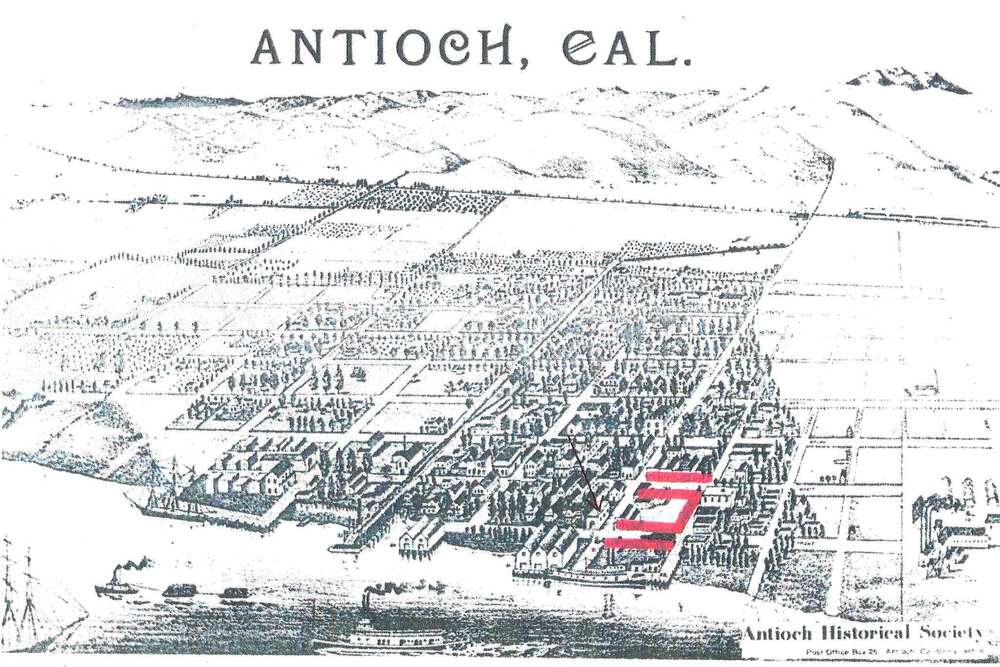
Before the white residents of Antioch burned down Chinatown in 1876, they banned Chinese people from walking the city streets after sunset.
In order to get from their jobs to their homes each evening, the Chinese residents built a series of tunnels connecting the business district to where I Street met the waterfront. There, a small Chinatown and a cluster of houseboats made up the immigrant settlement. If they ever felt safe there, it was fleeting. Above the tunnels and outside their doors, the threat of violence was simmering. "The citizens of Antioch have been endeavoring to rid themselves of the Chinese for some time,” the Sacramento Bee wrote in the spring of 1876.
When the Palace Hotel was demolished in 1926, workers discovered secret tunnels underground used by Chinese residents to commute after sunset. According to an 1851 statute, Chinese residents were not allowed to be on the street after dark.
The excuse they were waiting for came on April 29, 1876. According to newspaper reports, a doctor in Antioch made public the knowledge that a handful of young men he treated showed signs of venereal disease. The doctor pointed the finger at Chinese sex workers; he knew what he was doing.
Outrage ripped through the town. A mob quickly formed. Some urged murdering the women, but “better counsels prevailed,” a wire report recounted. Instead, the swarm of four dozen angry white men went door to door in Chinatown, telling the occupants they had until 3 p.m. to leave town — no exceptions. Young, old, men, women, healthy and deathly ill had just hours to pack up and depart. It must have been an eerie sight: a crowd of frightened Chinese immigrants, their belongings knotted up into kerchiefs, standing silently in line at the dock, awaiting ferries to San Francisco and Stockton.
"The lightning of Caucasian wrath upon Mongolia has struck," the Mercury News wrote. But the spark it ignited had only just started to burn.
In the decades following the Gold Rush, no immigrant group was as loathed as the Chinese. That hatred became endemic to California, planted and nourished by politicians, city leaders and the media. Their xenophobic talking points will sound familiar today: outrage over “low skill” laborers taking jobs from white people, complaints that Chinese people failed to integrate into American society (while simultaneously barring them from schools, social gathering places and even public streets) and accusations of “an invasion.”
"Anti-Chinese sentiment is right, patriotic, and in every sense American,” the Los Angeles Herald declared in 1876.
By the 1870s, California had moved from local ordinances, like Antioch’s street ban, to creating entire anti-Chinese political parties. San Franciscan Denis Kearney, himself an immigrant from Ireland, formed the Workingmen’s Party of California. Its stated goal was to eradicate Chinese workers and its infamous slogan was: “The Chinese must go!” The state constitution ratified in 1879 had only one article that addressed a racial or ethnic group. Entitled “CHINESE,” it banned corporations from hiring “Chinese or Mongolian” people and specified "no Chinese shall be employed on any State, county, municipal, or other public work, except in punishment for crime." Three years later, the federal Chinese Exclusion Act would bar all Chinese laborers from immigrating altogether.
It was in this hateful, volatile atmosphere that white Californians began setting arson fires in Chinatowns. It was easy to burn down entire settlements because laws often restricted what parts of town they could live in, clustering everyone in the same few blocks.
The day after Antioch’s Chinatown was emptied, it was physically eradicated. As churchgoers left Sunday services, rumors began to spread that some Chinese residents had returned home. No one now living can reveal what exactly happened next. But by 8 p.m., someone had set Chinatown on fire.
Continue to Part 2